
Preserved transit system / finalist case study

Campus transit, rebuilt as a kinetic control system.

SlugLoop turned live GPS hardware, Firestore, Express, React, and Google Maps into a student-built shuttle tracker for UCSC. This archive now frames the project like the system it was: operational, precise, and moving.

Fleet signal

Firestore-backed vehicle state

Campus loop

Stops, hills, routes, and Metro overlap

Build mode

Hardware, backend, map, and product

SlugLoop OS

campus transit control

Signal live
Live artifact routeUCSC loop

Telemetry frame

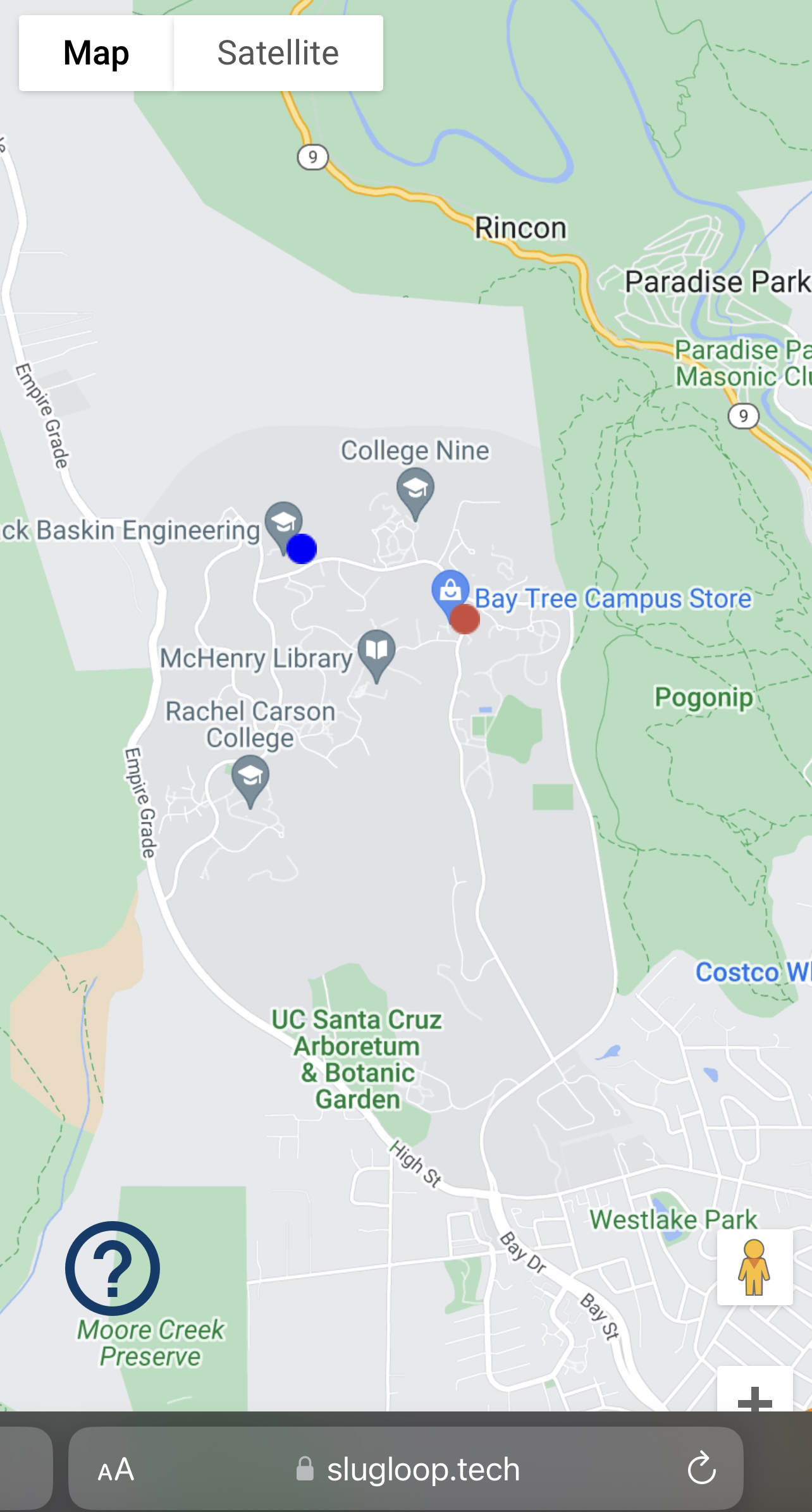
Preserved map logic, abstracted into a command-view route.

Science Hill

Quarry Plaza

East Field

Cowell

ETA

02:14

Route

Loop

Metro

5 lines

Fleet signal

Realtime

Campus loop

UCSC

Build mode

Student-led

01

Top 10

global Google Solution Challenge finalist

02

Only US

team in the 2023 global finalist group

03

4 students

built the first working version at UCSC

04

500+

commits across the open-source project

System profile

A practical app with real operational depth.

The flow now follows the product story: pressure, signal, software, public proof. Each section has room to breathe while still feeling like one continuous route.

Problem

Transit pressure

A campus where timing the loop bus mattered.

UCSC students were making daily tradeoffs around unpredictable loop shuttles, steep hills, full Metro buses, and late arrivals. SlugLoop started from that frustration and turned it into a visible system.

Hardware

Real devices

The project reached below the web app.

The team reprogrammed existing GPS-emitting hardware and worked with campus base stations so shuttle positions could move from physical buses into a real-time software pipeline.

Software

Full stack

A student-built data pipeline became a live map.

React rendered the map, Firestore carried real-time vehicle state, Express handled ingestion and Metro sync, and Google Maps gave riders a familiar view of campus movement.

Recognition

Public proof

The work traveled beyond campus.

SlugLoop was recognized by UCSC News, local press, Santa Cruz Works, Devpost, and the 2023 Google Solution Challenge as a student-built response to a real transportation problem.

Architecture

From bus ping to moving pixel.

The preserved map still mirrors the original system shape: physical hardware produced the signal, the backend normalized it, Firestore carried state, and React rendered campus movement.

GPSExpressFirestoreGoogle Maps

01

GPS hardware

Reprogrammed bus hardware emitted location pings from the campus fleet.

02

Base stations

Campus receivers forwarded raw data toward the SlugLoop backend.

03

Express ingestion

A Node/Express server validated pings, normalized data, and wrote Firestore documents.

04

Firestore

Collections for buses, Metro vehicles, and bus stop ETAs became the app data layer.

05

React map

The client read Firestore and rendered route-filtered vehicles and stops on Google Maps.

Recognition

Public proof, not portfolio filler.

Coverage from campus and local outlets gave the project external weight, while Google's finalist stage proved the student system could travel beyond Santa Cruz.

UCSC News

SlugLoop reaches the Google Solution Challenge global finals

Read source

Santa Cruz Sentinel

UCSC team makes final round of Google app challenge

Read source

Santa Cruz Works

CruzHacks team in the Top 10 Google Solutions Challenge

Read source

Devpost

Original hackathon project page

Read source

Route log

The build story now reads like motion.

A compressed path through discovery, prototype, beta, finalist stage, and archive mode. The full timeline keeps the longer record intact.

January 2023

1. The frustration became visible

Student conversations around unreliable campus shuttle timing framed the problem SlugLoop would solve.

January 2023

2. CruzHacks formed the team

Bill Zhang, Alex Liu, Annie Liu, and Nicholas Szwed formed the project team and began turning the idea into a working app.

February 2023

3. Hackathon prototype

The team built the first version during CruzHacks and earned recognition for its use of GitHub.

March-May 2023

4. Public beta and competition run

SlugLoop was released as a public beta and submitted to the Google Developer Student Clubs Solution Challenge.

April 2023

5. Top 100 selection

The project advanced into the Top 100 projects in the Google Solution Challenge.

Visit the archive route

Crew

Four students carried the whole stack.

The team section is deliberately compact: enough personality to humanize the system without breaking the forward momentum of the page.

Bill Zhang

Bill Zhang

Product, full-stack development, and project leadership

LinkedIn
Alex Liu

Alex Liu

Backend, data pipeline, and frontend development

LinkedIn
Annie Liu

Annie Liu

Frontend, UI/UX, and product experience

LinkedIn
Nicholas Szwed

Nicholas Szwed

Backend, hardware, and embedded systems

LinkedIn

Retrospective

A map demo, a case study, and a signal that still holds.

SlugLoop is no longer positioned as a commuter utility. It now works as a polished archive of shipped work, public impact, and technical range.

Built for a real campus mobility problem, not a classroom prompt.

Integrated physical bus hardware, base stations, backend services, and a web client.

Shipped an open-source PWA with Google Maps and Firestore-backed real-time data.

Coordinated with campus staff and local transit context while staying student-led.

Earned public recognition from UCSC, local press, and Google Solution Challenge judges.